
Frequently Asked Questions
Quality and device compatibility
The display’s right-side Quality panel includes size alignment. Keep Auto normally; try 8 or 16 px for device-specific picture issues. Only this display is changed. Actual dimensions follow encoder constraints and may be slightly below the selected limit. Failed changes attempt to restore the previous configuration. Lower quality reduces transmission and decoding load but cannot guarantee removal of all latency.
iOS USB connection
After selecting Install / repair Apple device support on Windows, the page shows component checking, actual download percentage, file and signature verification, and the waiting-for-installer stage. The pre-install Apple service check does not depend on capture-driver checks. Complete the Windows administrator prompt and Apple licence wizard; use the taskbar if the wizard is hidden. Retry a failed download, or select Download the official Apple component manually to download the same official MSI, run it, then return and select Detect again. A completed download does not mean installation succeeded.
If Apple device support is missing or its service is stopped, install or repair that component first without waiting for a full device and capture-driver scan. Once the Apple service is ready, the client checks the connected device's capture driver. If prompted, select Install capture driver for this device and approve the administrator request.
USB and wireless mirroring are independent. After selecting USB in this panel, switching to Android and back to iPhone / iPad does not start the wireless receiver; selecting Wireless enables that channel. Switching guide pages does not automatically stop a wireless receiver that is already enabled.
If USB video works but enabling control reports missing USB components, reinstall the complete client. Control has its own runtime libraries; do not download DLLs from unknown sources, disable security protection, or repeatedly reinstall phone drivers.
macOS uses built-in Apple USB support and does not require the Windows Apple device support package or capture driver. The client must bundle its USB capture and control helpers; users do not need to install Python. If a helper is missing, reinstall the complete client rather than following the Windows driver steps.
Windows prerequisite checks cover the capture driver service, file integrity and signature, Apple parent driver and device filter. Ready does not replace actual video validation. Unplugging during connection reports a disconnected device; stopping intentionally does not report connection failure. Re-enabling control waits for the previous control process to release its resources before opening a new channel.
The USB page is under Add device → iPhone / iPad → USB. Connect a data cable, trust the computer on the phone, then select the device to start mirroring. Open its device card after video arrives. USB control is separate from wireless Bluetooth control and uses the existing focus-window toolbar.
The Windows USB connection steps include a separate reminder: After installing or reinstalling the components, if you have tapped Trust but no device appears below, unplug and reconnect the USB cable, then select “Detect again”. First follow the standard instructions to unlock the phone and trust the computer. If the device already appears in the list below, there is no need to reconnect the cable.
macOS USB taps, drags, and computer keyboard input have been verified on the connected phone, not across all devices. English keys, Shift, Backspace, and Enter are supported; use the phone input method for Chinese. An OS upgrade is not a prerequisite for this verification.
The Windows USB page provides installation actions for Apple device support and the connected device's capture driver. Administrator approval and user acceptance of Apple's license are required; there is no need to disable system security. Enabling control checks Developer Mode and developer support components and attempts to prepare missing components. Mirroring and control use USB without automatic Wi-Fi or Bluetooth fallback. Control availability depends on the phone's operating system and device checks; viewing remains available when control is unsupported.
If the Windows capture driver is installed but USB video is missing after reopening, use Repair USB connection on the USB page. Stop USB mirroring first and accept the administrator prompt. This reconnects only the selected iPhone, without restarting the shared Apple service or replacing drivers. If recovery still fails, reconnect the cable and unlock the phone.
Clicking an idle USB card immediately shows Connecting. Repeated clicks during connection do not start additional requests; identical errors are grouped, and you can retry after the connection attempt finishes. When the device is detected as disconnected or mirroring is stopped, the current connection wait ends without waiting for the first-frame timeout; reconnect the device to retry.
Windows Security says part of this app has been blocked. What should I do?
Windows has blocked a component the client is trying to load. This is not the same as a bad USB cable or missing trust approval on the phone. A signed installer does not guarantee that every installed EXE and DLL passes system checks. Wireless reception, USB capture and USB control can be affected separately.
- Keep Windows security protection, Smart App Control and driver signature enforcement enabled. Do not turn them off for mirroring or replace installed DLLs with downloads from unknown websites.
- Save a screenshot of the warning and record the blocked file's full name and path, the time, and whether you were using wireless mirroring, USB mirroring or USB control.
- Save logs under Settings → About → Export logs and send them with those details to support. If the client cannot start, provide the warning details first. Verify the installer's source, then update or reinstall using the complete package supplied by support; do not sign components yourself.
Bundled client runtime components must receive the appropriate signature and integrity checks from the publisher. They are separate from the official Apple device support MSI downloaded on demand: that package has its own Apple installer and requires administrator and licence approval. Installing Apple support cannot repair a blocked client runtime library. Passing signature checks does not establish that every system policy or actual mirroring path has been validated.
Contact support and diagnostic logs
After a successful upload, the diagnostic ID appears under Settings → About → Export logs. Click it to copy it, then send it to support when reporting the problem in chat. Support can use the ID to locate the matching diagnostic attachment on the same event.
Selecting Online chat, Telegram or Email under Contact support uploads the same diagnostic ZIP as Export logs in the background, as explained under Settings → About → Export logs. Logs are not additionally redacted and may contain device identifiers, paths and diagnostics; select a channel only if you agree to provide this information. No login is required: a persistent installation ID associates the report. Support can locate the associated logs in the backend after upload. Device information is context, not a diagnosis that a particular phone is faulty.
Contact remains available during upload or failure. Concurrent requests merge; successful reports are reused for two minutes. Archives above 20 MB, network failures or missing desktop logs prompt manual export in Settings instead of silent truncation. Nothing is automatically posted to the Telegram group. This only uploads logs when contacting support, without automatic error capture or source upload.
Connection and control essentials
- Android supports USB and LAN connections from multiple clients. Avoid simultaneous dragging. Confirm the wireless picture is live before unplugging USB. Performance depends on the network and devices.
- Multi-view and group control include available Android devices only. iPhone / iPad retain independent mirroring and device management, without multi-view or group control.
- Windows and macOS support direct iPhone control over compatible Bluetooth hardware. Follow the illustrated guide to enable Accessibility › Zoom, restore normal picture size, then verify a tap. Linux does not support iOS control. This is not USB control.
Plugin page and custom packages
Plugins beside All devices opens a full page, not a catalog dialog. Search plugins, manage built-in WeChat enhancement, or drop a local .zip / .vmosplugin package. New packages start disabled; review permissions before enabling. Enable, disable and uninstall synchronize to open displays without interrupting mirroring.
The plugin center separates Browse plugins, User plugins and Developer docs. Details show permissions and compatibility; WeChat settings and phrases remain built-in. Searchable offline documentation covers the integration model, manifest, device/app hooks, toolbar, panels, permissions/actions, lifecycle, errors and acceptance. Three installable examples demonstrate app notes, app-specific tools and text filling. Current hooks are declarative, not executable scripts; foreground app detection and text filling are Android-only and never send automatically. Online distribution, auto-updates and persistent plugin storage are unavailable. See Custom plugin development. Plugin cards offer details and enable/disable controls; only user-installed plugins can be uninstalled. Plugins currently support Android devices only. The client interface and built-in plugins follow the language setting; user-installed plugin content is displayed as supplied by its author, without automatic translation.
WeChat quick replies
Enable WeChat enhancement and manage phrases under Plugins; no separate installation is needed. Quick replies appear on the right of a controllable Android display while WeChat is foreground. The panel expands beside the picture rather than covering it.
The entry is based on the foreground app, not the country or region of the phone number used to sign in to WeChat. If it is missing, check the enhancement switch and whether display control is enabled. On connection, the client checks companion-service capabilities. It loads a matching service instead of reusing one without phrase replacement, without forcibly stopping an older service used by other clients. Fully quit and reopen the desktop client after updating to load the new connection logic. If an older client on another computer still holds control permission, update it too and fully quit its old process; closing only its display window is not enough.
- Create, edit, delete, copy, import and export phrases, or search by title. Phrases contain a title and text, without groups or favorites.
- In an independent display window, Fill replaces all input with the selected phrase without sending; Send replaces all input and then sends that phrase. Any existing draft is replaced, not combined with the phrase. Multi-view still inserts at the current cursor and does not support quick sending.
- Select Enter or Ctrl/Cmd+Enter to send the current input without replacing it or inserting a phrase; it does not need to match a saved phrase. The default retains normal key behavior. Shift+Enter inserts a newline and IME confirmation does not send.
- While a send-shortcut request is pending, further typing or clicking in this client, or taking focus away from the display window, cancels the send before it executes. Do not edit the draft or switch chats on the phone or another client during the operation; those actions are outside this window's cancellation detection.
- Recognition uses the chat title and controls flanking the input, supporting light and dark portrait layouts with different status-bar heights. Chat wallpapers and keyboard skins are not used to identify the input. Sending does not transcribe the draft or wait for an empty-field caret to blink. Offline OCR regression covers varied backgrounds, keyboard skins, font sizes, multiline drafts and compressed low-resolution images. An obscuring overlay or an unconfirmed chat or Send button prevents the click; messages are never resent automatically. Landscape, split-screen, repackaged or cloned apps and non-Chinese WeChat interfaces are not fully verified; compatibility with every third-party theme is not guaranteed.
- First opening shows preparation progress. Empty Enter, missing Send and page changes end silently. A completed replacement without a Send click does not show an unknown-outcome warning; check the WeChat input. Normal sending has no result toast; check WeChat for the outcome. Unknown text-write or send-control results and connection errors still show a notification; check before clicking again. Phrases stay on this computer; exports contain message text and should be kept private.
Ordered by connection, device status, the device wall, the focus window, group control, batch operations, iPhone, settings, and updates.
Connecting and Adding Devices
Why does one Android phone have two cards? Can both control it?
USB and LAN connections retain separate cards, and both support control with consistent screen power state. Closing one focus window leaves the other open. Competing input from another window cannot interrupt an ongoing gesture. Group-control and batch targets are deduplicated when their serial number or cloud-device identifier matches. Names and model labels alone are never used to merge targets.
Do I need to install an app on the phone?
No. Connecting to an Android device opens a temporary casting and control channel; nothing is left installed on the phone after you disconnect. iPhone and iPad use Apple's built-in Screen Mirroring, so no app is needed there either.
Which devices are supported?
Android physical phones, Android cloud phones, and iPhone / iPad. Android 8 is the minimum Android version.
iPhone and iPad connect over Screen Mirroring with no app installed on the phone. What you can do depends on your computer's OS:
| Computer OS | Mirror the iPhone screen | Control the iPhone |
|---|---|---|
| macOS | Yes | Yes · requires a one-time Bluetooth pairing |
| Windows | Yes | Not yet supported |
| Linux | Yes | Not yet supported |
Only one iPhone can mirror at a time.
What format should I enter?
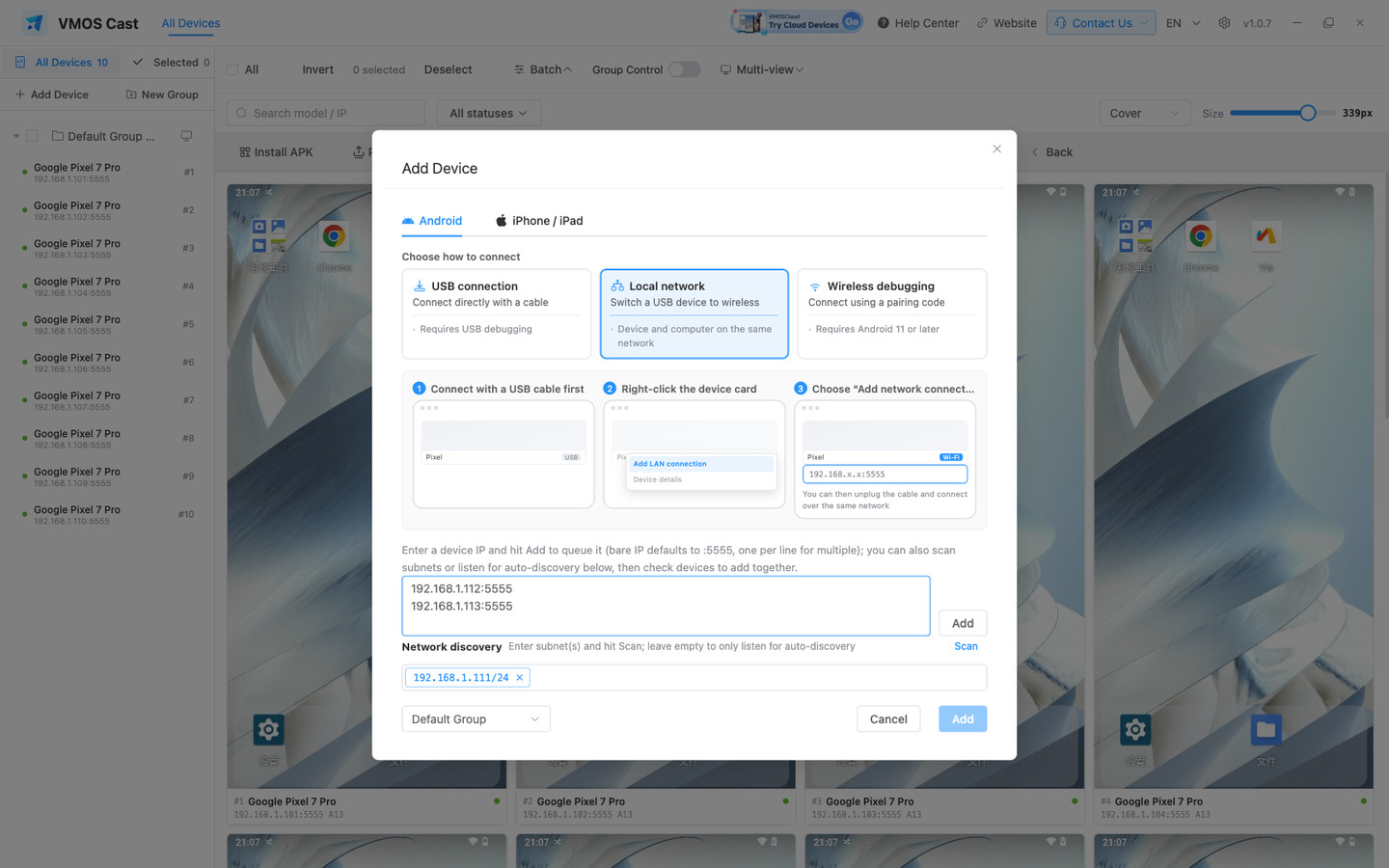
Use IP:5555, for example 192.168.1.100:5555. If you enter only 192.168.1.100, VMOS Cast uses port 5555. Multiple devices can be separated by new lines, spaces, or commas.
Can VMOS Cast scan devices on the same LAN?
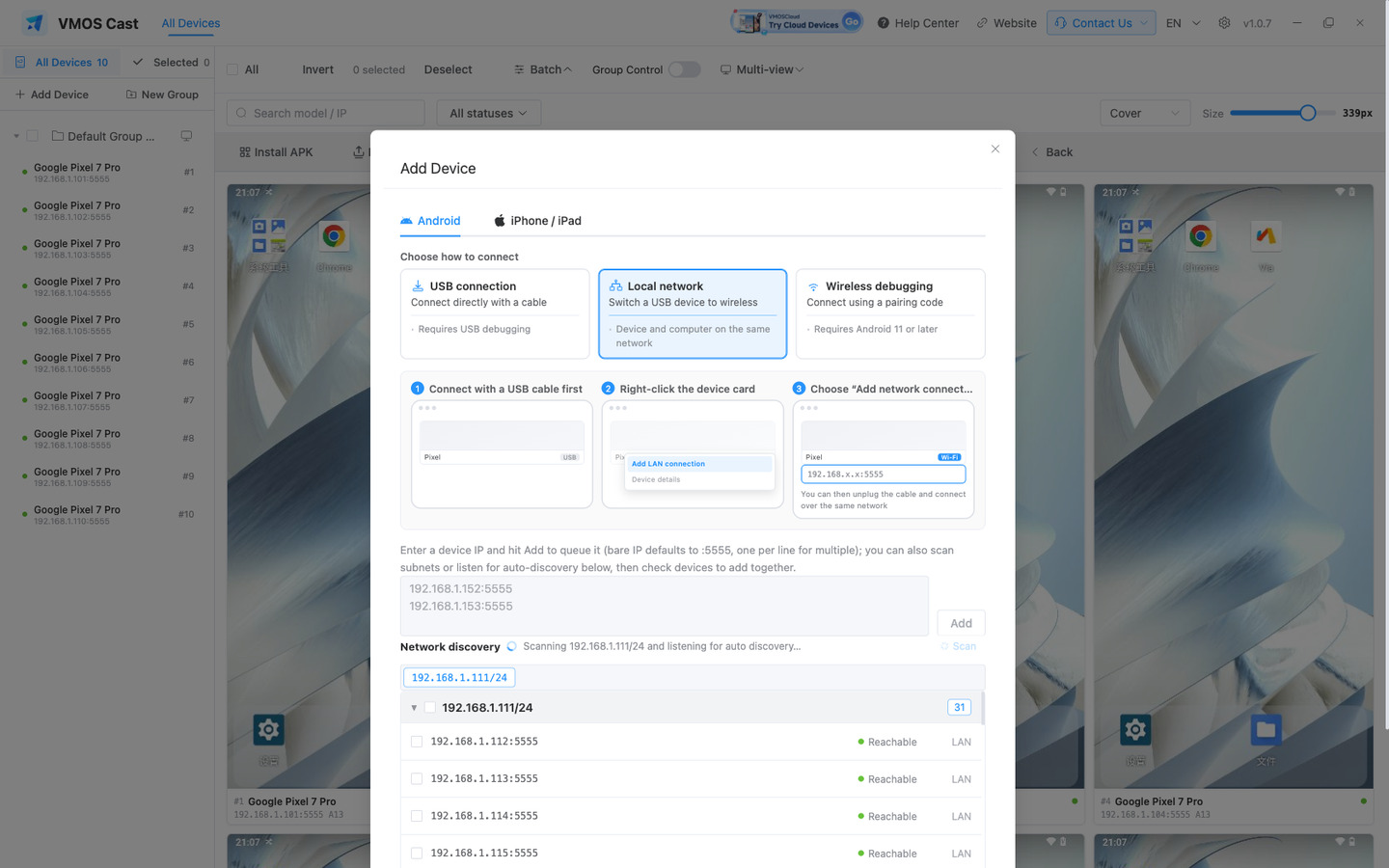
Yes. Click Add Device, pick Local network under the Android tab (the dialog opens on USB connection), then use Network discovery at the bottom of the dialog: enter a subnet and click Scan (you can also click it without a subnet to just listen for device broadcasts), tick the devices you want, and click Add. Devices already on the wall are marked as added and are not listed again.
What does "Pairing required" mean in the scan results?
That device has wireless debugging enabled with a pairing code, so adding it directly will not work. Click the entry to open the pairing dialog and enter the six-digit code shown under "Pair device with pairing code" on the phone. Tick and add the device once pairing succeeds.
Scanning finds nothing, or no pairing address is discovered
Discovery relies on broadcasts within the same subnet. Different subnets, guest networks, and client isolation all block it. Enter the address manually instead:
- Adding a device: type
IP:5555in the input field - Wireless debugging: type the IP address and port shown in the phone's pairing dialog
Pairing failed — what do these messages mean?
| Message | What to do |
|---|---|
| Wrong pairing code | Close and reopen the pairing dialog on the phone to get a new code, then retry with it |
| Cannot reach the pairing port | The pairing dialog on the phone was closed. Reopen it and try again |
| Pairing succeeded, but the device did not connect within 60 seconds | Make sure Wireless debugging is still on and the phone is on the same network as the computer |
Why does a physical phone need USB before IP connection works?
Physical phones do not allow wireless connections by default. Connect over USB first, then right-click the device card and choose Add LAN connection — after that the cable can be unplugged. This LAN connection is turned off when the phone reboots, so it has to be enabled again over the cable (a device paired through wireless debugging is unaffected — see the next question). See LAN connection: first-time Wi-Fi setup.
Can I connect a physical phone without a cable?
On Android 11 and above, use Wireless debugging: click Add Device, choose Wireless debugging, then on the phone open Settings → Developer options → Wireless debugging → Pair device with pairing code, and enter that code in the dialog. Pair once and the phone reconnects automatically after a reboot.
Cloud phone cannot connect?
Check three things first: the IP is correct, the computer can reach that network, and the cloud-phone platform has port 5555 open. On corporate networks, also check VLAN boundaries, guest network isolation, and firewall rules.
USB is plugged in, but nothing happens?
Look at the device wall first — it already narrows this down by half:
- An orange "Device not authorized" card → the computer already sees the phone; all that is left is tapping "Allow" on it.
- The wall stays empty → the computer has not detected it. Usually a switch in Developer options is still off (each vendor adds its own beyond "USB debugging"), or it is the cable, the port or a missing driver.
What to do in each case: Troubleshooting a connection. For the per-brand switches, see Enabling USB debugging (by brand).
Will devices reconnect automatically?
Yes. Addresses added manually or through scanning are saved and retried on the next launch. If you remove selected devices or delete an address from Saved devices, it will not auto-reconnect again.
Device Status Reference
The same wording appears on the cards of the device wall and as an overlay in the focus window (Connection timed out and Video is off appear in the focus window only). What separates these states is not the colour — it is whether they clear on their own:
| Status | Meaning | Recovers on its own | What to do |
|---|---|---|---|
| Device offline | The device is no longer reachable: powered off, unplugged, or off the network | ✓ Reconnects once the device is back | Check the device's power and network. Select the card and click Remove selected if you no longer need it |
| Device not authorized | The computer sees the device, but "Allow USB debugging" has not been tapped on the phone | Yes — connects as soon as you allow it | Click "How to authorize" on the card, then tick "Always allow" and tap Allow on the phone |
| Failed | The device is online, but this connection has not been established | ✓ Keeps retrying | Wait about half a minute. Remove and re-add only if it keeps failing |
| Connection timed out | No picture after repeated reconnects; retrying has stopped | ✕ | Close the focus window and open it again. Restart the device if there is still no picture |
| Restricted by system security | The current page has screen-capture protection enabled | ✓ Returns when the page is left | Leave that page on the device. On some models the window stays usable |
| Screen is off | The device screen is turned off | ✓ Returns once the screen is on | Open the focus window and click Wake screen, or press the device's power button |
| Video is off | The video channel is disabled — a setting, not a fault | ✕ | Settings → Streaming Settings → Channels, enable Video, then reopen the focus window |
★ Except for Device offline, the device stays connected in all of these states, and the card still opens a focus window.
The Device Wall and Groups
Can I select and group Apple cards? Why do they remain when not casting?
Apple cards show a live preview while casting and return to the "Not casting" placeholder when casting stops. Both the sidebar and card show the reported model on the first line (iOS if unavailable) and the device name on the second. A custom client alias replaces the second line without changing the name on the phone. The Screen Mirroring device identifier remains in device details; it is not a hardware serial number. Previews reuse the video stream already received on the computer, without starting another cast on the phone, and continue while casting even after the focus window closes.
Yes. Select the name area below the card or its sidebar row, then choose "Move to group", or use the card's context menu. The wall, sidebar and counts use the same records. A record remains marked "Not casting" to preserve its alias and group; this is not proof that the device is online. Clicking its inactive casting area shows connection guidance. Remove unwanted records; starting a new cast can add them again. Apple cards do not offer Android's LAN setup, reboot or shutdown commands, and management support does not enable Android group control.
How do I select a device?
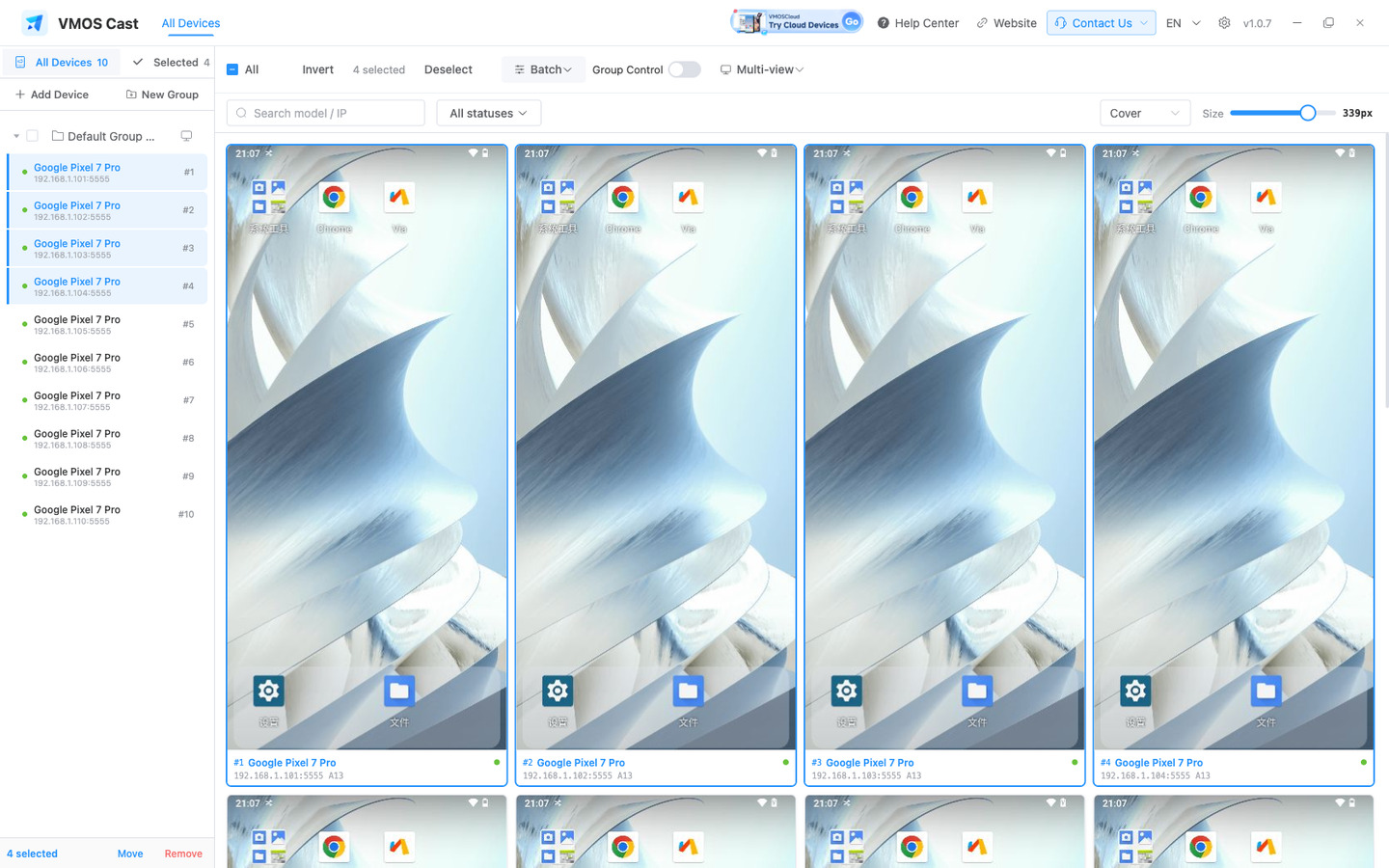
Click the bottom or edge area of a device card. A selected card gets a blue border. Clicking the screen area opens the single-device focus window instead.
Which devices does Select all choose?
Only currently visible devices. Search or switch to a group first, then click Select all to apply batch operations only to that set.
What can the Status filter filter by?
Status in the toolbar is a multi-select dropdown with six entries, each showing a live device count: Online · Connecting · Screen off · Not castable · Failed · Offline.
- Statuses are combined with OR, and combined with the search box and the group in the sidebar using AND
- Counts reflect the set left after the current search and group filter
- The filter is not saved — every launch starts with all statuses shown
What is the small monitor icon in the top-left corner of a card?
It means a focus window is already open for that device. Clicking the card's picture again does not open a second window — it brings the existing one to the front.
A card says "Screen is off" and the picture is black
The device screen is off; this is not a casting fault. Open the focus window and click Wake screen, or press the device's power button — the picture returns as soon as the screen is on. The button is not placed on wall cards; wake devices from the focus window.
What is the difference between "Device offline" and "Failed"?
- Device offline — the device itself is gone: powered off, unplugged, or off the network. The card is kept and the device is picked up again as soon as it returns
- Failed — the device is still online, this particular connection just has not come up. VMOS Cast keeps retrying and it usually recovers within half a minute
A quick check: if the phone responds normally in your hand but shows as offline, look at the network or the address. If it shows Failed, let it recover.
How long should a card stay on "Connecting"?
A few seconds is normal, and with many devices the first pictures appear one after another. If a card stays on Connecting for more than about half a minute, VMOS Cast rebuilds that connection automatically; if there is still no picture, treat it as Failed.
Does switching groups disconnect other devices?
No. Groups only filter the view. Other devices keep their connections and reappear when you return to All Devices.
Can I give a device a name I recognise?
Yes. Right-click the card → Rename and enter an alias; leave it empty to restore the default name (brand + model). The alias is stored on this computer only — it does not change the device's own name and is not shared with other computers.
How do I tell which connection a device is using?
Right-click the card → Device details. The Connection row reads USB, LAN, or Wireless debugging.
A device connected over USB can be turned wireless with Add LAN connection in the same menu, after which the cable can be unplugged. All three behave the same on the device wall — they differ only in how the device is attached and in what happens after it reboots.
How do I remove devices I no longer need?
Select devices, expand Batch, then click Remove selected. If the device was saved as a manually added address, that saved address is removed too.
Can I restart or power off a device remotely? Can I power it back on?
Right-click a device card for Restart and Power off. Both ask for confirmation and are disabled for offline devices.
- Restart — casting stops and the connection is restored automatically once the device is up, usually within a minute
- Power off — the device cannot be switched on remotely. Someone has to press its power button. Use with care on deployed devices
The Focus Window
What can I do in the focus window?
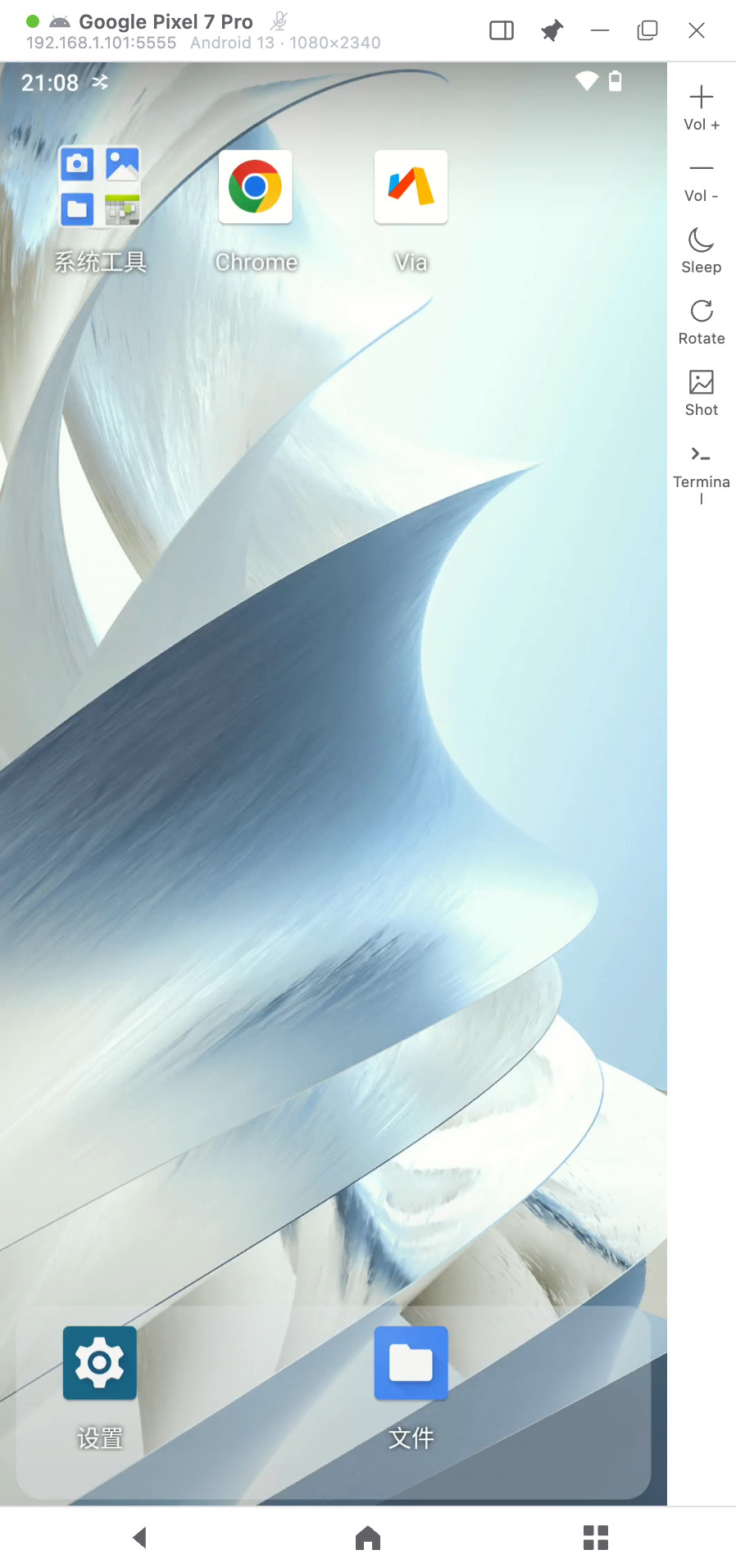
Click, drag, scroll with the mouse wheel, right-click Back, middle-click Home, type with the keyboard, adjust volume, turn the screen off or on, rotate, take screenshots, and open a terminal to run commands. If the device screen is off, right-click or middle-click wakes it without also triggering Back or Home. Esc closes the window without dropping the connection on the wall.
Can I type directly with the computer keyboard?
Yes. Tap the target input field on the phone first so it has the cursor, then type on the computer keyboard — IME input works. During Pinyin composition, the active spelling stays visible at the bottom of the mirrored screen and disappears after a candidate is committed. Cmd / Ctrl + V pastes the computer's clipboard onto the device.
Why do some pages show no picture?
Those pages turn on screen-capture protection — common on password, payment, and DRM-protected video screens. Android blocks capture there and the card reads "Restricted by system security". This is not a VMOS Cast failure.
Some devices can keep casting on these pages: the picture still shows and stays clickable, so you can even type the lock-screen PIN in the window. Normal casting resumes when the page is left. Whether the picture appears depends on the device's Android version.
The picture is still there on a password page, but it says the frame rate was reduced and offers "Restore live view"
That is the case described above. On a protected page the system limits capture, so the picture is delivered at a lower frame rate; it stays fully viewable and clickable. It switches back automatically when the device leaves the page, and Restore live view switches back immediately.
Two phones on the same password page — why does only one still show a picture?
Whether a page with screen-capture protection can still be shown is decided by the device's own system, not by anything configured differently on the two phones.
- Supported devices — the picture stays visible and clickable, so a lock-screen PIN can be typed in the window, and casting returns to normal once the page is left
- Unsupported devices — the system blocks the picture completely, the card reads "Restricted by system security", and the page can only be operated on the phone
Seeing both behaviours across one batch of devices is normal and needs no investigation.
The window says "Connection timed out" — will it recover by itself?
No. Connection timed out is a final state reached after repeated reconnects produced no picture, and retrying has stopped so the device is not tied up indefinitely. Close the focus window and open it again to retry; restart the device if there is still no picture.
The window says "Video is off" — is something broken?
No. The video channel has been disabled in the settings, leaving only audio and control. Enable Video under Settings → Streaming Settings → Channels, then reopen the focus window.
Unfolding a foldable or rotating the screen flashes "Resizing screen"
That is expected. When the device resolution changes, the window is re-fitted to the new aspect ratio, and a placeholder is shown during the transition so the picture is never stretched. It takes a second or two.
What is the difference between Standard, Minimal, and Immersive?
| Style | What is shown |
|---|---|
| Standard | Title bar + side toolbar + bottom navigation keys |
| Minimal | The device picture plus a narrow title bar |
| Immersive | Picture only; the title bar appears when the pointer moves to the top of the window |
Switch under Settings → Cast window → Focus window; it takes effect the next time you open a device. The toggle in the title bar changes the current window only and does not change the default.
What is the Terminal button on the right for?
It opens a command line for that device inside the focus window, for advanced troubleshooting such as inspecting system properties, processes, and logs. The window widens automatically so the picture is not covered. Select text and press Cmd+C (Ctrl+Shift+C on Windows and Linux) to copy to the computer clipboard; Ctrl+C still interrupts the running command. Android devices only.
Can several computers control the same device at once?
Yes, with no limit on the number. Each computer has its own windows and input session and can operate the device directly — there is no control token to wait for — and closing one computer's session does not affect the others.
Group Control and Multi-view
How do I operate several devices at the same time?
Use Group Control:
- Select 2 or more devices that are already showing a picture on the wall
- Click Group Control in the toolbar
- The first device opens as the master, with "Master · N" shown at the top
- Every tap, swipe, and drag in the master window is mirrored to the other selected devices
Group Control syncs screen gestures only. Keyboard input goes to the master device only. To run the same action across a set of devices (install, uninstall, command, screenshot), use batch operations.
It says group control needs at least 2 streaming devices selected
At least two of the selected devices must already be showing a picture. Selecting a single device, or devices that are still connecting, offline, or not castable, does not qualify. Wait for the pictures to appear and click Group Control again.
What is Multi-view, and why are some devices missing from it?
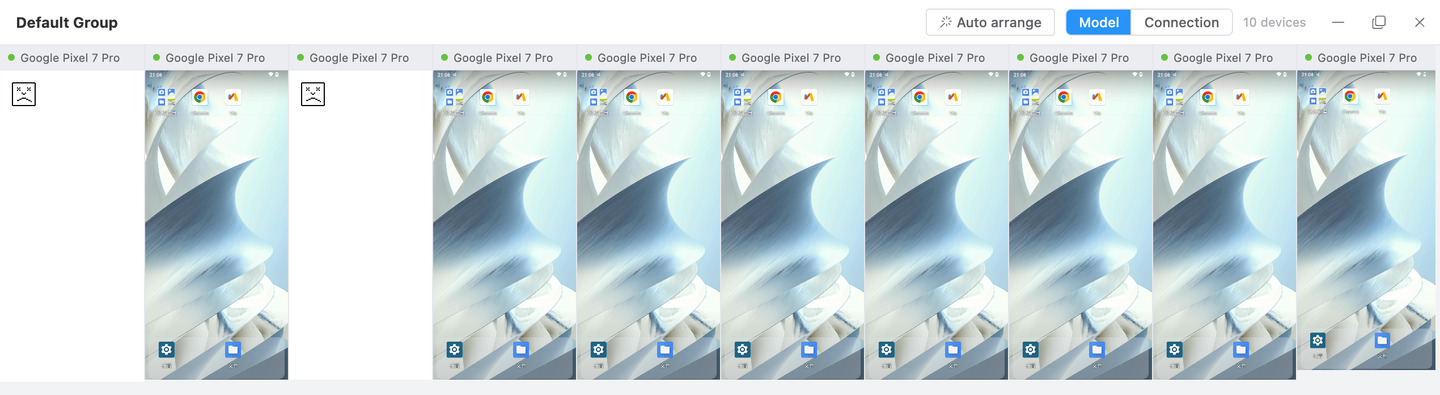
Multi-view shows all devices of one group in a single window, and every tile can be operated directly with the mouse. Open it from the monitor icon next to a group in the sidebar, or from the Multi-view dropdown in the toolbar.
- A multi-view holds up to 16 devices. Anything beyond that is not shown and a notice reports how many were left out. Split the group if it is larger
- Members are a snapshot taken when the window opens: adding or removing devices in the group afterwards does not change an open window. Close and reopen it to refresh
- Auto arrange prioritises keeping every device fully visible, scaling panes down and leaving space when needed. Slight contact does not swap panes. A target swaps into the drag-start position only when more than half covered and both panes fit, without overlap or pushing other panes downward
- To move the whole window, drag its title or the empty area of the top title bar. To deselect a pane, click empty workspace or switch windows
- Quick replies are available only in the Android single-device window toolbar, not in Multi-view.
Why is there no Wake screen button on a multi-view tile?
Tiles are reduced-size views that show status but carry no action buttons. Use the expand button on the tile's title bar to open that device's own focus window, and click Wake screen there.
Batch Operations
Where are batch operations?
Select devices first, then click Batch in the top toolbar.
Which file formats does batch install accept?
Installation accepts apk / apks / apkm / xapk, and several files can be selected at once. Push File accepts any format.
Why does batch APK install fail on some phones?
Common causes include phone-side install confirmation, mismatched old app signature, low storage, expired USB debugging authorization, or unstable network. Test on one or two devices before running it on a whole group.
Where do I find the package name that batch uninstall asks for?
Package names look like com.example.app. The quickest way to get one is Run Command in the batch panel: pick "List 3rd-party" from the command presets and find the app in the output.
Is batch uninstall safe?
Batch uninstall cannot be undone. Confirm the package name, test on a small set, then run it on the group.
Run Command says offline devices were excluded, or that all selected devices are offline
Commands run on online devices only. The first message means some of the selected devices were skipped while the rest ran normally; the second means none of the selected devices were online, so nothing ran. Refresh the device states or change the selection, then run it again.
How do I export the IP addresses and models of a set of devices?
Select the devices → Batch → Copy Info. Tick the fields you need (device ID, IP address, name, resolution, Android version), choose a separator (comma, new line, pipe, or space), check the preview, and copy to the clipboard — ready to paste into a spreadsheet.
Where do pushed files land on the phone?
In /sdcard/Download. When the push finishes, each device reports where its file was stored, and failures are explained device by device.
Where are batch screenshots saved?
They are saved to the folder set in Settings → Streaming Settings → Screenshot location. Batch screenshots and focus-window screenshots both go there, and saving no longer prompts you for a location. If you have not changed it, the default is VMOS Cast inside your computer's Pictures folder. After a batch you get "Saved N/M screenshots" together with the full folder path, and Settings has an Open folder button.
File names automatically include the device name and timestamp (e.g. Pixel 7 Pro-20260827-161105.jpg), so they never overwrite each other. Capturing many devices repeatedly uses resources and disk space, so wait for one round to finish before starting the next.
Batch screenshot reports a save failure
That is a problem on the computer side, not on the device: the screenshot folder was deleted, moved to an external disk, or is not writable. Pick a writable folder under Settings → Streaming Settings → Screenshot location and try again.
Individual devices report their own reason instead. The two common ones are a screen that is off, and a page with screen-capture protection enabled.
iPhone and iPad
The phone responds smoothly, but the computer picture lags or stutters
Compare the phone, focus window and thumbnail. If the phone has responded but the computer picture has not updated, investigate video reception, decoding or window relaying rather than simply increasing pointer speed. Export the client logs and note whether only the focus window is slow and whether remote desktop is in use. The iPhone display prioritizes source resolution, but network conditions and computer load still affect smoothness; Android display quality and bitrate settings do not control iPhone.
iPhone / iPad support independent mirroring and management, without multi-view, Android group control or batch commands. Viewing does not require Bluetooth. On Windows and macOS, choose Enable control in the independent display and follow the illustrated pairing guide; Linux is view-only. Losing Bluetooth leaves mirroring running. Closing the display preserves wall thumbnails. Inactive records can still be selected, renamed, moved or removed. Configure Auto-Lock on the phone.
How do I connect an iPhone or iPad?
Nothing to add in the Add Device dialog · mirroring starts from the iPhone. Put the iPhone on the same Wi-Fi as the computer, swipe down from the top-right corner to open Control Center, tap Screen Mirroring, and pick this computer. It then appears on the device wall automatically.
An iPhone card says "Not mirroring" — how do I start?
"Not mirroring" means that iPhone has connected before and is not mirroring right now; it is not a disconnection. On the iPhone, open Control Center → Screen Mirroring and select this computer again.
This computer does not appear in the iPhone's Screen Mirroring list
Check in order:
- The iPhone and the computer are on the same Wi-Fi network, and not on a guest network or one with client isolation
- The receiver status on the iPhone / iPad tab of Add Device. Click Retry if it reads "Receiver unavailable"
- Multicast and broadcast restrictions on corporate networks stop the iPhone from finding the computer — verify on an ordinary Wi-Fi network
Can two iPhones mirror at the same time?
No. Only one iPhone can mirror at a time, and a new one takes over from the previous one. Android devices have no such limit and can be mirrored together.
Can I control an iPhone from Windows or Mac?
Yes, with compatible Bluetooth and the Enable control guide in an independent display. Complete pairing and Zoom setup. Linux does not support iOS control.
The picture is visible or pairing succeeded, but taps do nothing
Mirroring and control are independent. Confirm the picture is live and Bluetooth connected, enable Settings › Accessibility › Zoom at normal picture size, then verify a tap using the guide. Connected status alone does not verify control. The retired AssistiveTouch pointer mode is not a prerequisite.
Does control lock my mouse in the phone picture?
Direct touch does not lock the computer pointer. Click the displayed target or hold the left button to drag; leaving the window releases contacts and keys. If taps are misplaced, check magnification and whether the picture has frozen. See iPhone control.
Why are there no screenshot, volume, or back buttons in an iPhone window?
Those are Android system keys and have no counterpart on iPhone, so they are hidden. An iPhone window has only the Control button in the toolbar and no bottom navigation keys. Use the iPhone's own button combination for screenshots.
Settings
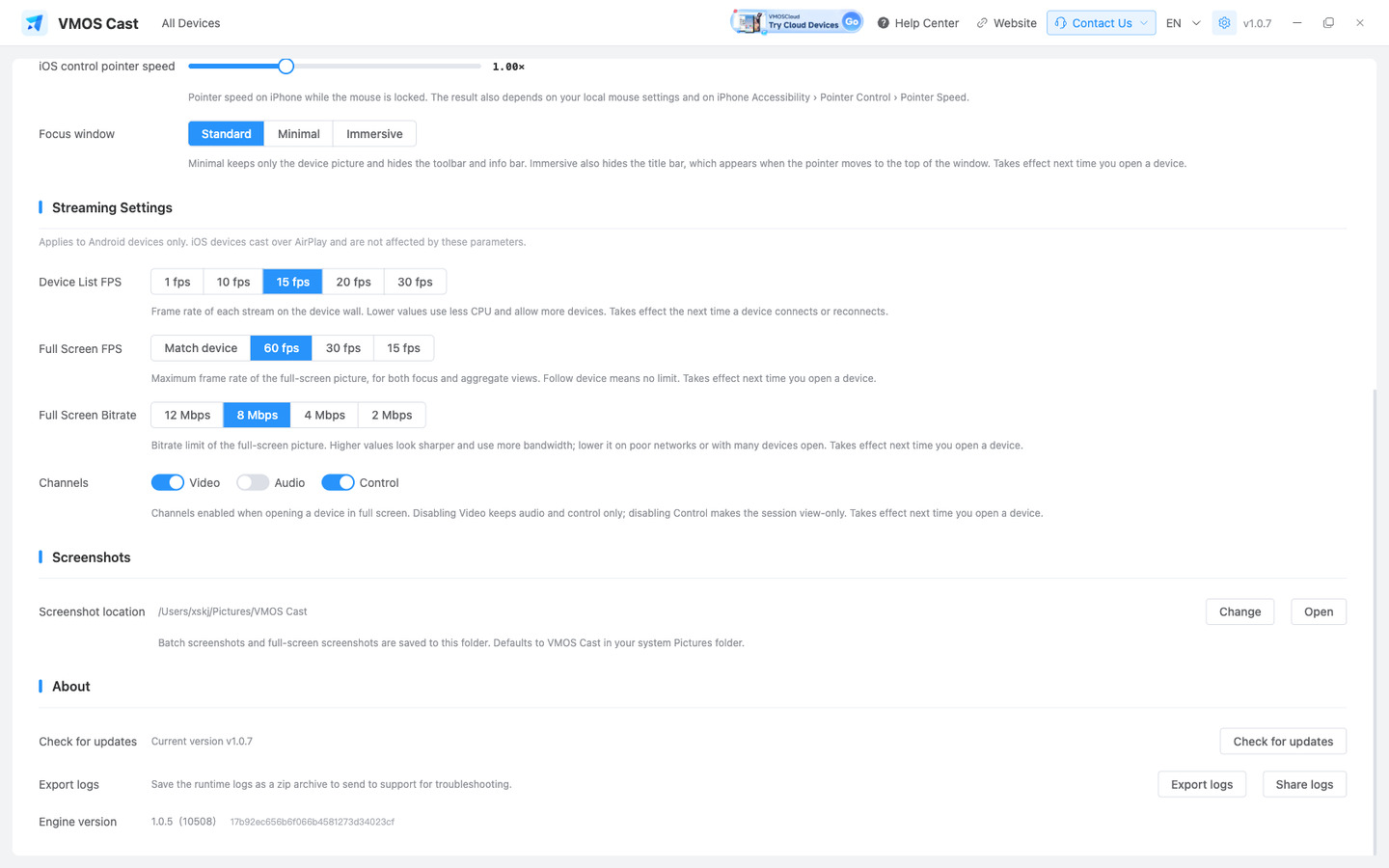
I changed the frame rate, bitrate, or channels — why did nothing happen?
Focus-window settings do not apply to windows that are already open; close the window and open it again.
| Setting | Takes effect |
|---|---|
| Thumbnail size | Immediately |
| Main window size, theme, language | Immediately |
| Full Screen FPS, Full Screen Bitrate, Channels, Focus initial size, Focus window style | Next time you open a device |
| Device List FPS | Next time a device connects or reconnects |
What do the three Channels switches do?
They decide which channels are opened when a device is opened in a focus window:
- Video — the picture. With it off, only audio and control remain and the window reads "Video is off"
- Audio — device sound played through the computer
- Control — mouse and keyboard input. With it off the session is view-only and the picture is unaffected
All three take effect the next time you open a device, and apply to Android devices only.
Many devices and everything is slow — which setting should I change?
Work out which layer is slow; the two sets of parameters are independent.
- The device wall is slow — lower Device List FPS and reduce the thumbnail size, and use groups to hide devices you are not watching
- A focus window is slow — lower Full Screen Bitrate first (8 → 4 → 2 Mbps), then drop Full Screen FPS to 30 or 15
If two picture streams from the same device compete on a constrained network, enable Pause list picture while full screen is open under Settings → Streaming Settings. The wall thumbnail then pauses while the device is in a focus or multi-view window and resumes when it closes. This setting is off by default.
To keep devices awake while you watch them, light the bulb button in the focus or multi-view title bar. It applies only to the current window and does not change device screen-timeout settings; turning it off or closing the window stops it immediately, and the choice is not saved.
If the picture looks blurry, first check whether the focus window's Quality panel was explicitly set to 720 / 1280 / 1920. Original restores the device picture and the Full Screen FPS and Bitrate from Settings. Android multi-view panes also request the original picture by default, even when made smaller. If compression remains visible at Original, raise the bitrate. Use a wired network where possible; with many devices, a lower frame rate is usually more stable.
Can I change the theme?
Yes. Settings → Theme mode offers light, dark, or follow system. The same page also covers theme color, main window size, thumbnail size, focus initial size, focus window style, device list frame rate, full screen frame rate and bitrate, channels, and screenshot location. The interface language (21 languages) is switched from the top bar.
How do I switch the interface language, and which languages are available?
Use the language button in the top bar. There are 21 languages, and the change applies immediately. Arabic and Urdu use a right-to-left layout, so the whole interface is mirrored.
The language affects the application interface only, not what the device itself displays, and it is independent of theme mode and theme color.
I closed the window but the app is still running — how do I quit completely?
It depends on Settings → Appearance → "Minimize to system tray on close":
- Off (default) — closing the window quits the application; no process is left running
- On — closing the window only hides the main interface in the system tray. The app keeps running and devices stay connected. Click the tray icon to restore the window; to quit completely, right-click the tray icon → Quit
Does Reset clear my devices and groups?
No. Reset restores the options on the settings page only (theme, frame rate, bitrate, channels, screenshot folder, and so on). The device list, groups, and device aliases are all kept.
Updates, Logs, and Troubleshooting
Where do I find versions and release notes?
Installers and release notes are all in Release History.
How do updates work?
VMOS Cast checks for updates silently on startup and prompts when a new version is found, with the release notes in the dialog. You can also check manually under Settings → About → Check for updates. Update now shows the download progress, speed, and estimated time remaining; restart when it finishes to install.
It says release notes are unavailable, or I ignored a version — can I still update?
- Release notes unavailable — the new version is out but its notes are not published yet. Check again later; this does not affect later updates
- An ignored version — after Ignore this version, that version is no longer offered and a manual check reports it as ignored. The next new version is offered as usual. To install the ignored version now, download the installer from Release History
What is "Server version" in the device details, and should I update it?
That is the version of the companion service running on the device; it is independent of the application version. When an Update button appears you can apply it — such updates usually improve casting stability and device compatibility.
Before switching versions VMOS Cast confirms that the device is not in use by another window or another computer, so an update never interrupts a picture someone is watching. If it reports that the device is in use, close those windows first.
A banner says device connection and mirroring are unavailable because program files are missing
Some program files were blocked by security software during installation and never reached the install folder, so device connection and casting are disabled. Click "How to fix" on the banner for the full steps:
- Add the install folder to your security software's trust list
- Reinstall the application — your devices and settings are kept
Where to add the exclusion:
| Security software | Path |
|---|---|
| 360 | Virus Scan → Trust List → Add folder |
| Huorong | Protection Center → Trust List → Add folder |
| Windows Defender | Virus & threat protection → Exclusions → Add a folder |
If both steps have been done and it still does not work, export the logs and contact support. This banner appears on Windows only.
It says the cast service is not running or is reconnecting, and all devices disappeared
The background service on the computer was interrupted; the devices did not all go offline at once. VMOS Cast reconnects automatically, and a Retry button is shown where one is useful. Devices are picked up again once the service is back — there is no need to add them a second time. Export the logs and contact support if it keeps happening.
How do I export logs?
Go to Settings → About → Export logs and save the zip file. It contains the computer's runtime logs, the full device-side logs, and on-site diagnostics. Send it with your support report to help us diagnose the issue faster. On macOS, Share logs builds the same archive and opens the system share sheet directly.
Can I use it offline?
Core casting and control only require the computer and devices to be on the same LAN. Downloading installers, reading online docs, and accessing a cloud-phone platform may still need internet.
Still Stuck?
See How to report a problem, and include the computer OS, connection method, screenshots, and exported logs.